DC to Cloud: Myths vs Reality for Enterprise Customers
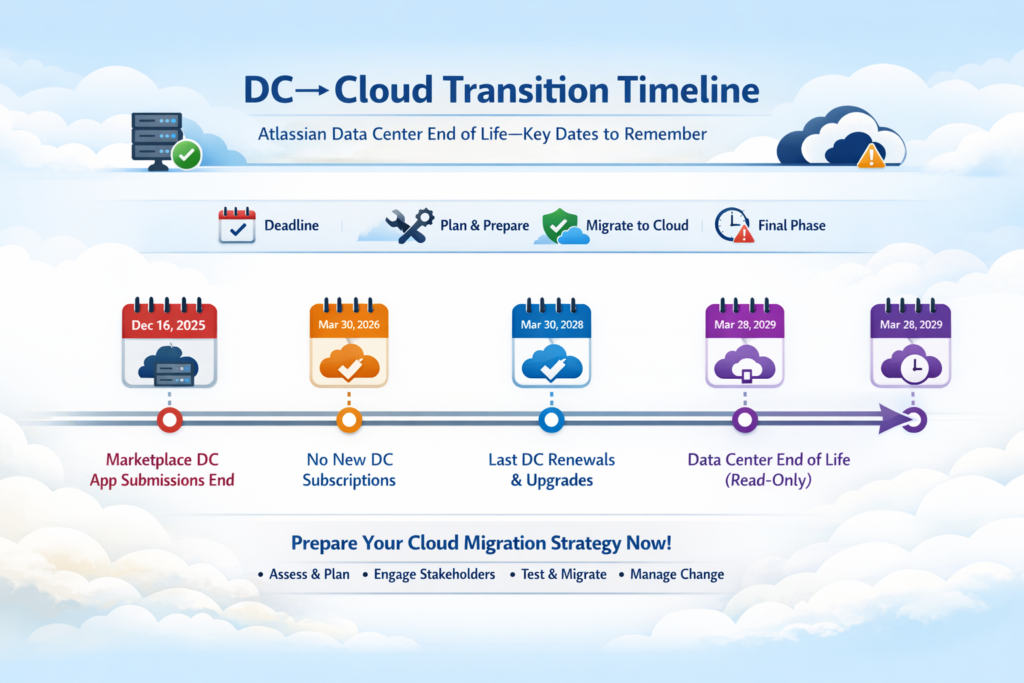
Atlassian has officially announced that its Data Center (DC) products will reach end of life on March 28, 2029, ushering in a cloud-first era for its enterprise collaboration and development tools. This includes flagship products such as Jira Software DC, Jira Service Management DC, Confluence DC, Bamboo DC and Crowd DC — all of which will be sunset in a phased manner over the next few years. Atlassian
For CIOs and enterprise technology leaders, this transition is more than a shift in licensing — it represents a strategic inflection point that requires careful planning, engagement with stakeholders, and thoughtful execution.
🚧 What’s Changing & Why it Matters
Atlassian has clearly communicated that Data Center products will enter their end-of-life lifecycle beginning March 30, 2026, when new customers can no longer purchase DC subscriptions, and culminate in read-only instances by March 28, 2029. Atlassian
This three-year migration window is designed to give organizations ample time to prepare, test, and execute their cloud transformation strategies.
The sunsetting of Data Center is driven by Atlassian’s focus on cloud innovation, scalability, and integrated AI-powered features that are either not available or cannot be reliably delivered on traditional on-premises infrastructures. With 99% of its customer base already in the cloud or on a migration path, the shift is both technological and strategic. Atlassian+1
📌 What CIOs Should Be Doing (2025–26)
1. Build a Formal Cloud Migration Roadmap
With the transition already underway, CIOs must lead from the front: establish a cross-organizational plan that aligns with the 2026–29 timeline, prioritizing mission-critical DC instances first.
2. Assess Application Dependencies & Compatibility
Understand which DC products and Marketplace apps your enterprise relies on, and verify cloud compatibility. Some third-party DC apps won’t have cloud equivalents, requiring workaround solutions or app replacements.
3. Engage with Stakeholders Early
Moving to cloud affects infrastructure, security, compliance, IP, performance SLAs and potentially cost models. Engage enterprise architects, security/compliance teams, and business unit owners to define success criteria for cloud transformation.
4. Leverage Cloud Migration Trials & Tools
Atlassian offers migration trials that allow DC customers to test cloud functionality with their actual data — a critical step to validating assumptions and surfacing migration challenges upfront. Atlassian Support
5. Plan for Change Management
Cloud adoption is more than infrastructure migration — it’s a change in workflows, integration patterns, and user expectations. Training, communications, and pilot programs are essential to minimize friction post-migration.
🔍 DC to Cloud: Myths vs Reality
Myth 1: Cloud Means Less Control
Reality: Modern cloud environments provide enterprise-grade controls, compliance certifications (including FedRAMP for certain offerings), and advanced governance tools that often outperform legacy on-prem setups. Atlassian
Myth 2: Migration Must Be Everything at Once
Reality: Migration can be phased. Many enterprises adopt dual-licensing or hybrid approaches, moving non-critical workloads first and iterating over time. Atlassian Support
Myth 3: Cloud Is More Expensive
Reality: While cloud subscription costs can seem higher initially, total cost of ownership often falls as the need for infrastructure maintenance, patching, disaster recovery, and hardware decommissioning drops.
Myth 4: Data Center Runs Forever
Reality: By late 2029, DC environments will be transition-only (read-only), forcing action or risk operational impact. Waiting until the last minute increases cost, risk, and organizational strain. Atlassian
🚀 Reality Check — Strategically Aligning IT & Business Goals
Moving from Data Center to Cloud isn’t just a technical exercise — it’s a business transformation that impacts agility, innovation, and competitive advantage. CIOs should view this as an opportunity to modernize workflows, embrace DevOps and automation best practices, and position the organization for accelerated growth with Atlassian’s cloud-native capabilities.
This strategic moment isn’t without challenges, especially for regulated industries concerned about data sovereignty or specific compliance mandates. However, advanced planning, early engagement with Atlassian partners, and careful migration testing can turn risk into advantage.