AI coding assistants have changed software development. Developers can generate code, fix bugs, write tests, and remediate vulnerabilities faster than ever.
But there is a new challenge emerging.
What happens when an organization has hundreds of AI agents working across thousands of engineering tasks?
Using AI is no longer the biggest challenge. Orchestrating AI effectively is.
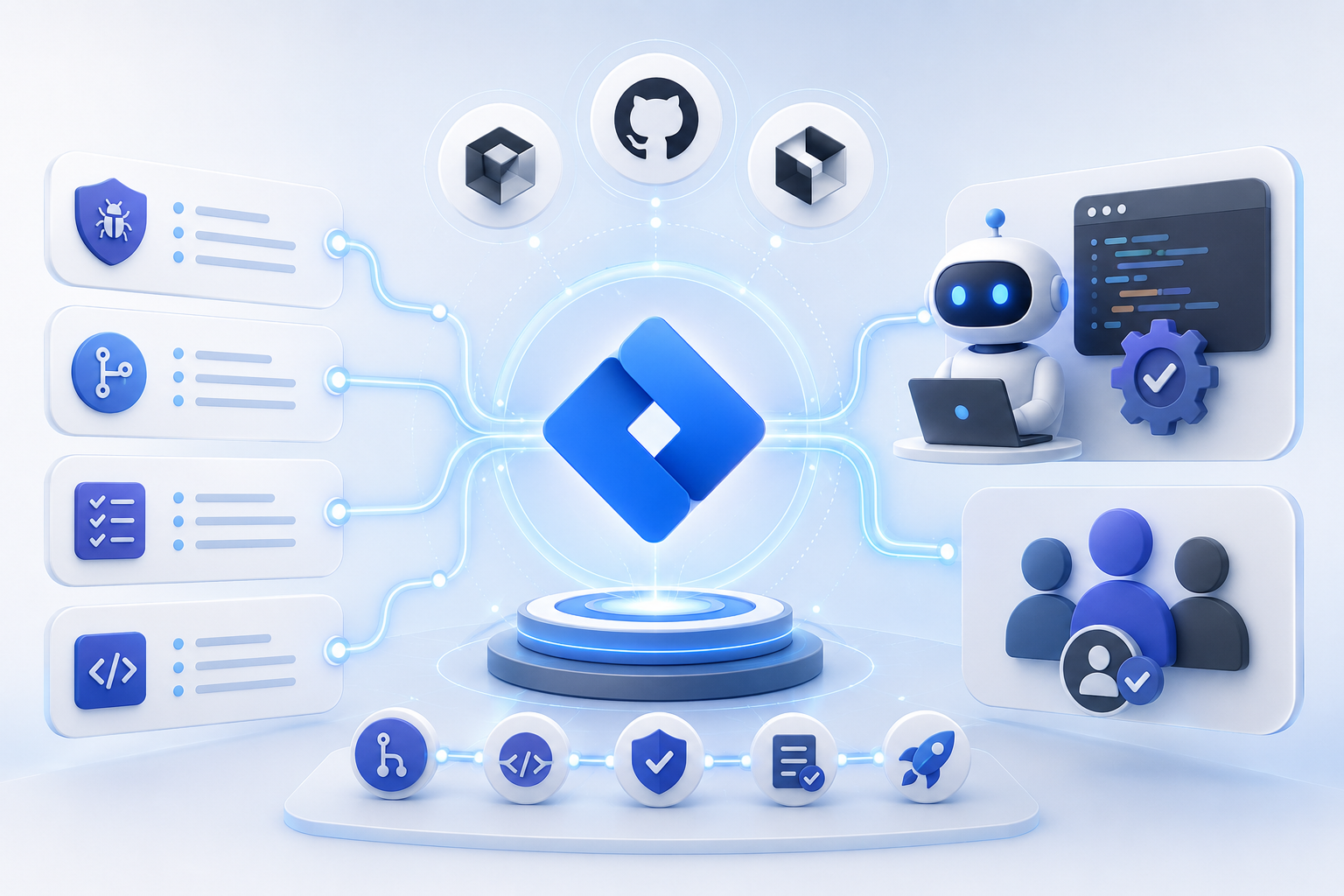
Atlassian is addressing this shift by expanding Jira Automation into an open control plane for AI coding agents, with support for tools including Cursor, GitHub Copilot, and Claude Code. The goal is simple: connect AI agents to the actual work, context, rules, and governance that engineering teams already manage in Jira.
For enterprises, this represents a significant evolution from AI-assisted development to AI-native engineering orchestration.
The Problem: AI Agents Can Code, But Who Coordinates Them?
Most organizations already have developers using AI coding assistants.
But agents often operate outside the enterprise workflow.
A developer receives a Jira task, copies the requirements into an AI tool, searches for documentation, provides additional context, reviews the output, and then manually updates Jira.
This creates another layer of work.
As Atlassian points out, the bottleneck is increasingly not the capability of AI models but the surrounding engineering workflow planning, context, alignment, review, and coordination.
AI can write the code. But the organization still needs to decide:
- Which task should an agent handle?
- Which agent is best suited for it?
- What context should the agent receive?
- When should a human step in?
- How should the outcome be tracked?
This is where Jira Automation becomes important.
Jira as the AI Control Plane
With the latest capabilities, Jira Automation can trigger AI coding agents based on real engineering events and conditions.
For example:
Vulnerability identified → Jira issue created → severity evaluated → AI agent assigned → fix implemented → pull request created → human review → issue updated.
Instead of manually initiating every AI task, organizations can create intelligent, event-driven workflows.
Atlassian describes this as an open control plane for AI coding agents, allowing third-party agents such as Cursor, GitHub Copilot, and Claude Code to become part of Jira-based workflows.
This changes the role of Jira.
It is no longer only a system for tracking engineering work.
It becomes the orchestration layer connecting people, work, context, and AI agents.
Where Enterprises Can Use AI Orchestration
The biggest opportunity is not replacing developers. It is automating repetitive engineering work while keeping humans involved where judgment matters.
1. Vulnerability Remediation
Low-severity vulnerabilities can automatically trigger an AI coding agent to investigate the issue, implement a fix, and create a pull request.
High-risk vulnerabilities can instead be escalated to the appropriate security or engineering team.
2. Engineering Maintenance
Routine work such as feature-flag cleanup, documentation updates, test generation, accessibility fixes, and bug remediation can be routed to agents automatically. Atlassian has reported using agent-based workflows internally to reduce time spent on certain engineering maintenance tasks by up to 80%.
3. Smarter Developer Handoffs
Jira can also pass work-item context directly to coding tools, reducing manual copy-paste and context switching. Atlassian currently supports integrations and handoffs involving tools such as Cursor, GitHub Copilot, Claude Code, Rovo Dev CLI, and others.
4. Human-in-the-Loop Engineering
Not every task should be fully automated.
The real enterprise advantage is controlled autonomy.
Agents can handle clearly defined tasks while complex or sensitive situations are automatically routed to human engineers.
Every agent invocation can remain connected to Jira’s workflow and audit trail, giving teams visibility into what happened and why.
Context Is the Secret to Better AI Outcomes
An AI agent is only as effective as the context it receives.
Jira connects work with requirements, dependencies, teams, documentation, and organizational knowledge. Atlassian’s Teamwork Graph further connects work, people, knowledge, and code, helping agents operate with richer enterprise context.
This means organizations can move from:
Prompt → Code
to:
Business intent → Jira work → Context → AI agent → Code → Review → Delivery
That is a much more scalable model for enterprise AI adoption.
What This Means for Engineering Leaders
The future of AI-native software development will not be determined simply by how many developers have access to AI tools.
It will depend on how effectively organizations orchestrate humans and AI agents together.
For CTOs and engineering leaders, the opportunity is to build an operating model where:
Routine work is automated.
Complex work is intelligently routed.
Context is always available.
Humans remain accountable.
Every action is measurable.