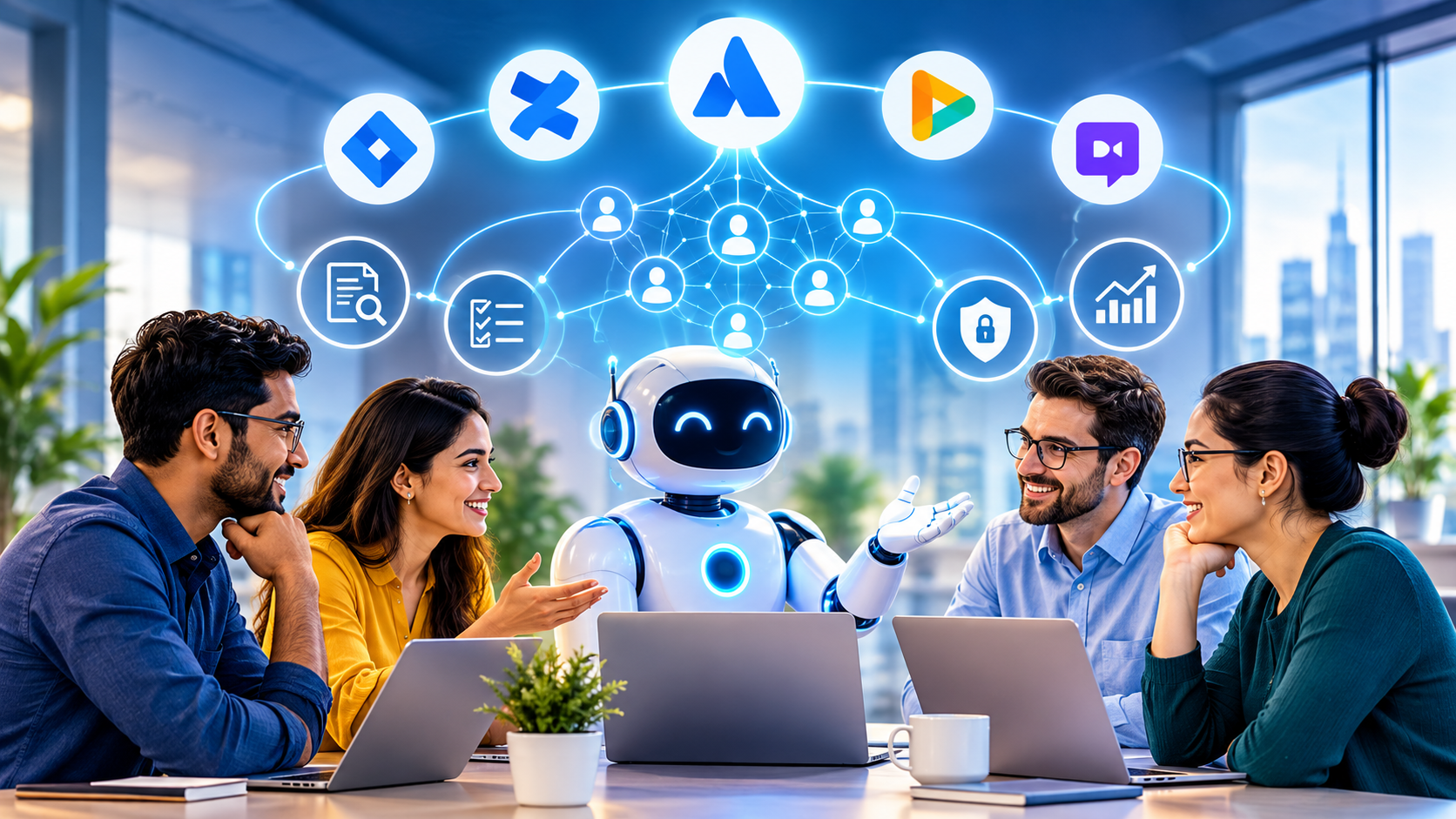
AI is moving beyond chatbots and assistants. The next stage is about humans and AI agents working together on real business processes sharing context, completing tasks, and making progress within governed workflows.
Atlassian’s latest platform announcements point strongly in this direction with its vision for human-agent collaboration and the introduction of the Agentic Multiplayer Protocol (AMP).
For enterprises, this could represent a significant shift in how work gets done.
From AI Assistance to AI Collaboration
Traditional AI tools typically respond to a prompt. An employee asks a question, generates content, or requests a summary.
Agentic AI is different.
AI agents can understand context, perform multiple steps, interact with connected tools, and complete defined tasks. Instead of simply helping an employee do the work, an agent can become an active participant in the workflow.
Atlassian describes this model as “multiplayer” work, where humans and agents operate together using shared context, defined authority, and reviewable outcomes.
The Role of Teamwork Graph
This model depends heavily on context.
Atlassian’s Teamwork Graph connects information about people, work, knowledge, communication, code, assets, and relationships. This allows agents to understand more than an individual task or document they can use the broader context surrounding the work.
For enterprises, this can help AI move from generic answers toward more relevant and actionable outcomes.
An agent working on a project, for example, could potentially understand the related requirements, decisions, documentation, conversations, dependencies, and responsibilities rather than operating with isolated information.
Why Agent Governance Matters
More capable AI also creates a bigger governance challenge.
Enterprises cannot simply give agents unrestricted access to business systems.
Agents need an identity. Their authority needs to be limited. Their actions need to be traceable, and humans need appropriate opportunities to review or approve important decisions.
This is where the Agentic Multiplayer Protocol (AMP) becomes significant.
AMP is designed around concepts including agent identity, scoped authority, shared context, tasks, and reviewable results.
The objective is not to slow AI down. It is to make AI useful and trustworthy at enterprise scale.
Connecting AI to the Flow of Work
Atlassian is also expanding how agents interact with its broader ecosystem. Recent Teamwork Collection developments include deeper connections between Confluence, Loom, Rovo, Jira, Slack, Microsoft Teams, and external agents.
This points toward a future where employees may not need to constantly move between applications to complete work.
Instead, agents can help carry context and actions across the workflow.
What Enterprises Should Prepare For
The transition to human-agent collaboration requires more than enabling AI features.
Organizations should start evaluating:
- Which workflows are suitable for AI agents?
- What level of autonomy should each agent have?
- What information can an agent access?
- Where is human approval required?
- How should agent activity be monitored?
- How will organizations measure business impact?
These questions form the foundation of an enterprise AI governance strategy.
The CRG Solutions Perspective
At CRG Solutions, we help enterprises prepare their Atlassian environments for the next generation of work.
That includes evaluating workflows, improving governance, connecting knowledge, enabling AI capabilities, and helping teams adopt automation responsibly.
The future of enterprise collaboration may not be humans versus AI.