How do enterprises deliver seamless service experiences across departments without increasing headcount?
This is the question every CIO, transformation leader, and shared services head is grappling with in 2026.
The answer is no longer just automation. It’s AI-powered, structured service delivery embedded into a unified system of work.
With the evolution of Jira Service Management into the Atlassian Service Collection, combined with intelligent AI agents and enhanced portal experiences, organizations are entering a new era: the Service Collection era.
From ITSM Tool to Enterprise Service Platform
The biggest shift in 2026 is the transition of Jira Service Management into the broader Atlassian Service Collection.
This isn’t just a rebranding it’s a strategic transformation.
Service is no longer limited to IT. It now spans HR, Facilities, Finance, and Customer Support—creating a unified service delivery model across the enterprise.
What makes this shift significant?
- AI agents are now core capabilities, not add-ons
- Service delivery becomes cross-functional and scalable
- Enterprises can operate with a single service model across teams
For leaders, this is a turning point. Treating this as a licensing update means missing the bigger picture: this is about redefining how work gets done.
The Smart “Front Door”: AI-Powered Portals
Traditionally, service portals were static—just forms and ticket queues.
In 2026, they’ve evolved into interactive, AI-driven service layers.
With AI agents embedded directly into portals (and platforms like Slack or Teams), employees and customers can now:
- Get instant, contextual answers
- Resolve issues without raising tickets
- Interact with always-on support systems
This dramatically reduces Tier-1 workload while improving user experience.
More importantly, AI agents operate in two powerful modes:
- Structured workflows (intents): Ideal for troubleshooting, triaging, and automating repeatable tasks
- Generative AI responses: Pulling answers from knowledge bases and historical data
This is where enterprise AI becomes practical. Your knowledge base is no longer static it becomes living operational intelligence.
Rovo Agents: Specialized AI for Every Function
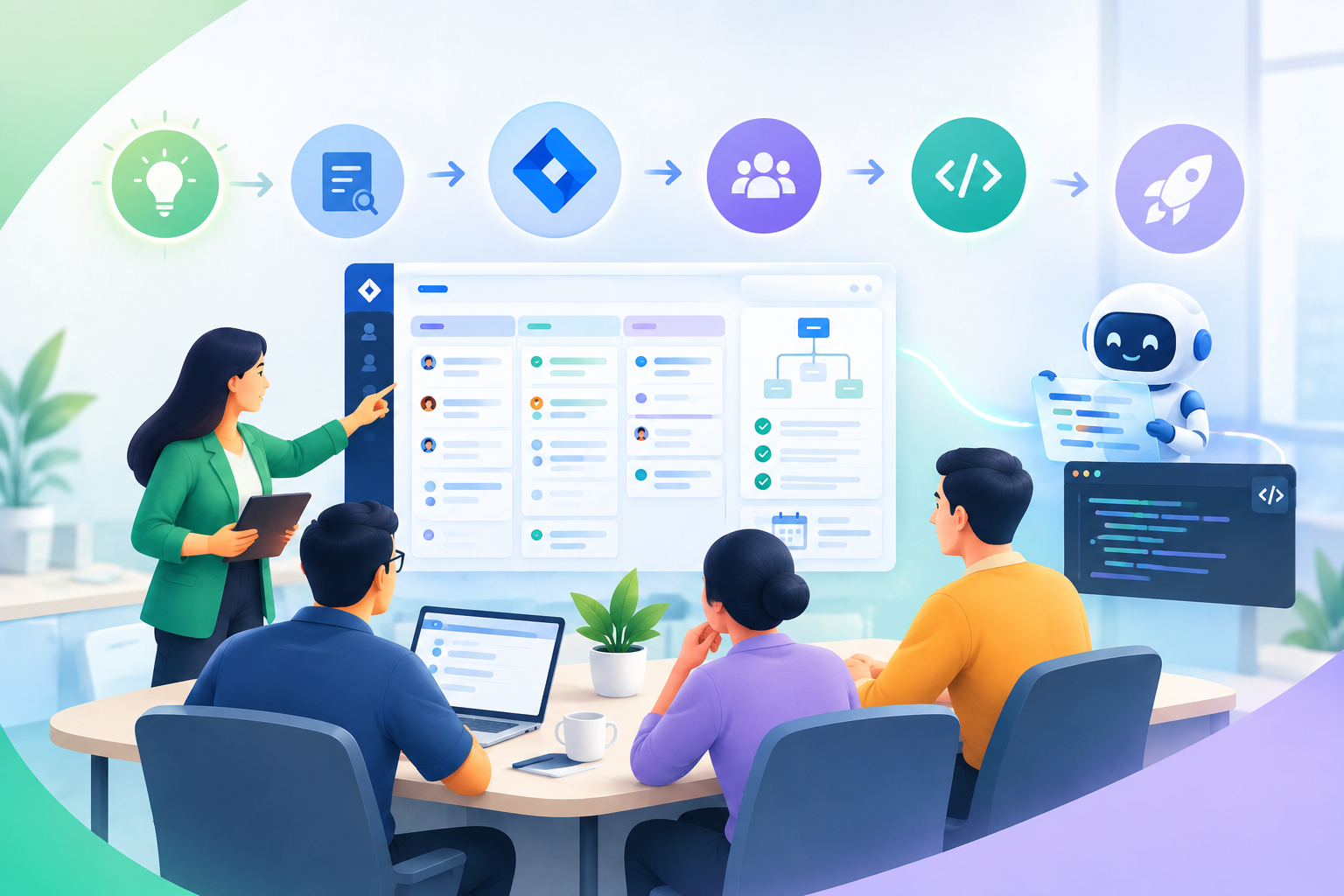
Another major innovation is the introduction of Rovo agents within service portals.
Instead of relying on a single chatbot, enterprises can deploy function-specific AI agents, such as:
- HR agents for onboarding and policies
- IT agents for access and compliance
- Facilities agents for requests and maintenance
- Customer service agents for real-time support
This transforms the service portal into a digital concierge, guiding users to the right solution instantly.
The result? Faster resolution, better user experience, and reduced operational friction.
AI Beyond Chat: Driving Service Efficiency at Scale
AI capabilities in Jira Service Management go far beyond virtual agents.
They now enhance every stage of service delivery:
- Automated summaries reduce context-switching
- AI-driven triage improves request classification
- Smart field suggestions standardize data capture
- Sentiment analysis helps prioritize urgency
- Incident intelligence groups alert and accelerates response
For enterprise leaders, the real value lies in consistency at scale.
AI ensures that service quality doesn’t depend on individual agents it becomes standardized, predictable, and measurable.
The Help Centre as a Strategic Experience Layer
The help centre is no longer just a directory it’s now a designed experience layer.
With enhanced customization capabilities, organizations can:
- Guide users toward self-service before ticket creation
- Design structured service journeys (discover → resolve → escalate)
- Align experiences with departmental needs and branding
Additionally, enterprises can create multiple help centres for different regions or business units—ensuring relevance at scale.
This shift turns the help centre into a conversion engine for service efficiency.
Turning Innovation into Measurable Outcomes
At CRG Solutions, we believe that tools don’t create value operating models do.
To unlock the full potential of the Service Collection era, enterprises must:
1. Design Service Like a Product
Identify high-volume requests, define automation opportunities, and build structured service journeys powered by AI.
2. Implement AI with Governance
Start with low-risk use cases, introduce intent-driven automation, and ensure data quality and access control.
3. Drive Continuous Improvement with Data
Track deflection rates, SLA performance, and sentiment trends to refine workflows and expand automation.
This is how organizations move from reactive support to proactive, intelligent service delivery.
Conclusion: Service as a Scalable Enterprise Capability
The shift to Service Collection, combined with AI-powered portals and specialized agents, marks a defining moment in enterprise transformation.
Service is no longer a support function it’s a strategic capability.
Organizations that embrace this model can:
- Deliver better experiences without increasing headcount
- Standardize service quality across departments
- Convert knowledge into automation
- Scale operations efficiently
The future of enterprise service isn’t just AI-driven it’s collaboration-powered, data-driven, and experience-led.
And those who act now will lead the next wave of transformation.